

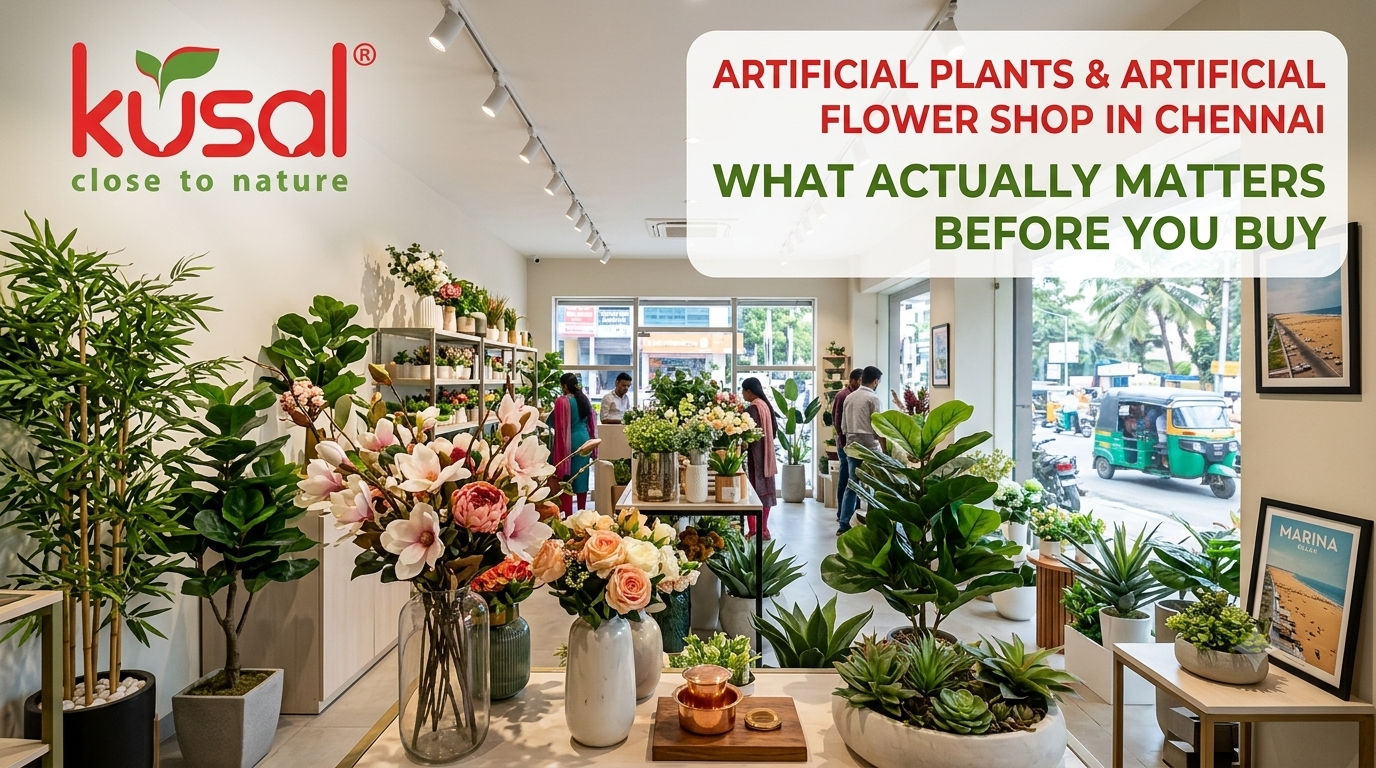

A practical look at why so many Chennai homes and offices are switching to artificial greenery, and how to pick a store that won’t sell you something that looks like it belongs in a dentist’s waiting room.
Walk into any apartment complex in Chennai these days and there’s a good chance you’ll spot a fiddle-leaf fig by the window that hasn’t dropped a single leaf in two years. Look closer and you’ll realise why — it’s not real, and it doesn’t need to be. Artificial plants and flowers have quietly become one of the most practical home-decor choices in the city, and for reasons that have a lot to do with Chennai’s particular climate, lifestyle, and the plain fact that not everyone has the time or patience to keep a living garden alive.
If you’ve been searching for an artificial plants store or an artificial flower shop in Chennai, this guide walks through what’s actually worth knowing before you spend money — not just a list of shop names, but the things that separate a good purchase from a regrettable one.
Why Chennai Is Warming Up to Artificial Greenery
Chennai’s weather doesn’t do real plants any favors. The city swings between long stretches of punishing heat and short, intense monsoon spells, and indoor plants often end up stuck in air-conditioned rooms that dry them out just as fast as the sun does outside. Add in water restrictions that crop up most summers, balconies that get harsh afternoon glare, and the sheer number of people living in apartments with little to no natural soil space, and you start to see why real plants are a tougher ask here than in a cooler, greener city.
Artificial plants sidestep almost all of that. No watering schedule to track, no worrying about a plant wilting while you’re away for a wedding in another city, no soil pests finding their way into your kitchen. For a lot of working professionals and small business owners in Chennai, that trade-off is an easy one to make.
What an Artificial Plant Actually Buys You
It’s worth being specific about the benefits, because “low maintenance” undersells it a little.
- Consistent appearance year-round — no seasonal dropping of leaves, no yellowing, no plant that looks half-dead by the time guests arrive.
- No pest or allergy concerns — useful in households with young children, pets, or anyone sensitive to pollen.
- Freedom of placement — you can put a plant in a dim hallway, a closed office cabin, or a spot with no natural light at all, somewhere a real plant would simply die.
- Lower long-term cost — no recurring spend on fertilizer, repotting, or replacing plants that didn’t survive the summer.
- Better fit for rentals — no soil spillage or water stains to worry about when you eventually move out.
Worth knowing: Good-quality artificial plants today use UV-treated, fade-resistant materials — a real shift from the shiny, obviously-plastic ones of a decade ago. The difference in look and feel between a cheap import and a well-made piece is bigger than most first-time buyers expect.
What to Check Before You Buy — At Any Store
Not every artificial plants store in Chennai sources the same quality, and it’s easy to get swayed by a display that looks great under shop lighting but falls apart once it’s home. A few things worth checking:
- Material and texture. Run your fingers over the leaves. Good synthetic foliage has a slightly matte, varied texture rather than a uniform glossy shine that screams “plastic.”
- Colour variation. Real leaves aren’t one flat shade of green. Better artificial plants mix in darker undertones and subtle yellowing on a few leaves to look natural.
- Base and potting. Check whether the plant comes in a proper weighted pot or just a foam block. A well-balanced base matters if you have kids, pets, or a breezy balcony.
- UV resistance. If the plant is going near a window or on a balcony, ask specifically whether the material is UV-treated — untreated plastic fades and turns brittle within a year of direct sun.
- Return or replacement policy. A shop confident in its stock will usually offer some kind of exchange window if a piece doesn’t hold up.
Artificial Flowers: A Slightly Different Set of Questions
An artificial flower shop in Chennai serves a different need than a plant store, even though the two often overlap. Flowers are usually bought for a specific moment — a wedding backdrop, a pooja setup, a festive centrepiece, a gift — rather than as permanent decor. A few things matter more here:
- Fabric vs latex vs silk-touch petals — each has a different look and price point, and it’s worth asking to feel the difference rather than choosing off a photo.
- Scent-free options — some decorative flowers are treated with fragrance, which isn’t always wanted indoors or around guests with sensitivities.
- Bulk pricing for events — if you’re decorating for a wedding or a large event, many Chennai stores offer noticeably better rates per stem when you’re buying in volume.
- Custom arrangements — a good flower shop will put together garlands, bouquets, or stage decor to a theme rather than just selling loose stems.
Real Plants vs Artificial Plants: An Honest Comparison
Artificial isn’t automatically the better choice for everyone — it depends on what you actually want from a plant.
| Factor | Real Plants | Artificial Plants |
| Maintenance | Regular watering, sunlight, pruning | Occasional dusting only |
| Air quality benefit | Yes, to a measurable degree | None — purely visual |
| Longevity | Depends heavily on care and season | Years, if kept out of harsh direct sun |
| Placement flexibility | Limited by light and airflow | Works almost anywhere |
| Upfront cost | Usually lower | Higher for good-quality pieces |
Plenty of Chennai homes end up doing both — real plants in a sunny balcony that gets proper airflow, and artificial ones in the living room, hallway, or office cabin where nothing would survive anyway. It’s less about picking a side and more about matching the plant to the spot.
Styling Artificial Plants So They Don’t Look Artificial

The giveaway is rarely the plant itself — it’s usually the placement. A few habits that help:
- Group plants of slightly different heights together rather than lining up identical ones in a row.
- Choose pots that suit the room — a plain concrete or terracotta-style pot usually reads more natural than a shiny plastic one.
- Add a thin layer of decorative pebbles or moss at the base to hide the foam block underneath.
- Dust the leaves every couple of weeks — a dusty artificial plant is the fastest way to make it look fake and neglected at the same time.
Finding the Right Store in Chennai
Chennai has a growing mix of dedicated artificial plant and flower stores, home-decor showrooms that stock a section of greenery, and online sellers who deliver across the city. Before settling on one, it’s worth:
- Visiting in person if possible, since photos rarely capture texture or colour accurately.
- Asking how long they’ve been selling artificial decor specifically, rather than as a side category.
- Comparing a few options for the same plant type — pricing for something like a fiddle-leaf fig or areca palm replica can vary quite a bit between stores.
- Checking if they handle bulk orders, since event decor and office fit-outs often need volume pricing that a single-piece retail shop won’t offer.
Final Thoughts
Artificial plants and flowers have moved well past the point of being a compromise — for a lot of Chennai households and businesses, they’re simply the more practical choice given the climate and lifestyle here. The key is buying from a store that takes quality seriously, checking the material and finishing yourself rather than trusting a photo, and choosing pieces that suit where they’ll actually sit in your home or office. Get those details right, and it’s genuinely hard for most visitors to tell the difference.

Leave A Comment